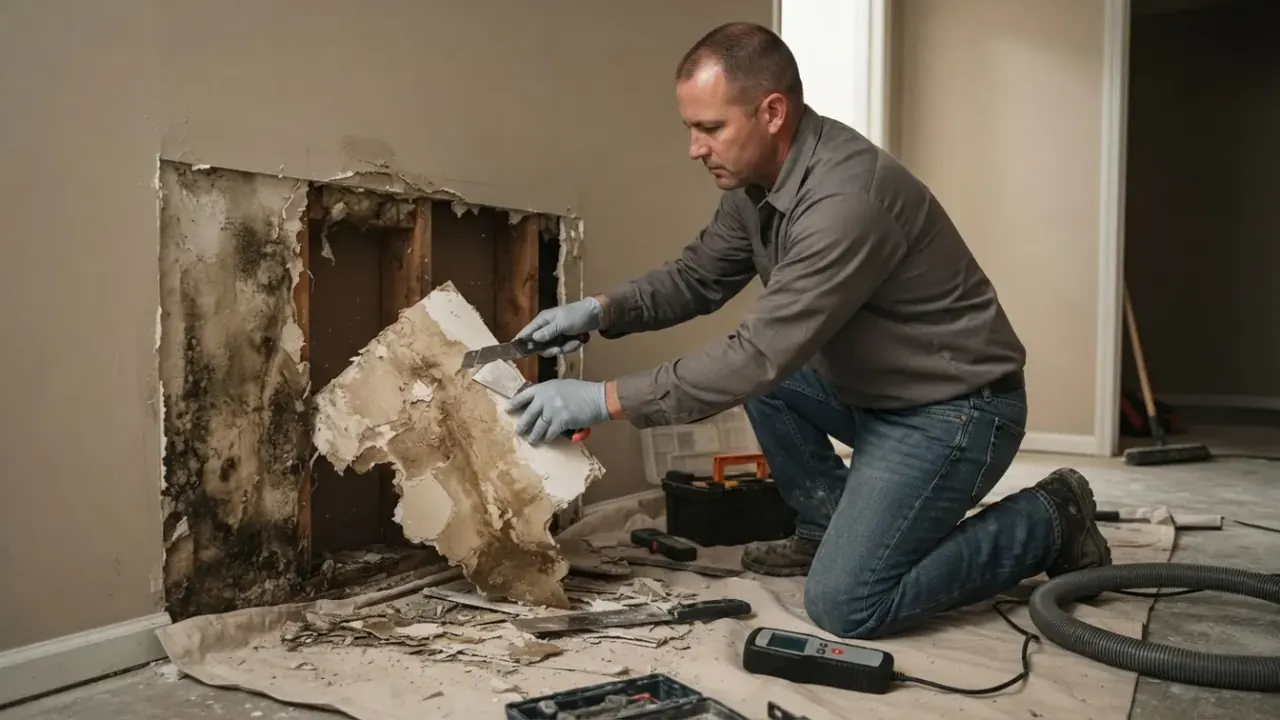
Fixing water damaged drywall on an exterior wall means stopping the water at the envelope first, drying the cavity to under 16% moisture content, then cutting out and replacing the ruined drywall. If you patch the drywall before you fix the leak, the same wall will be wet again after the next hard rain. That is the whole answer in two sentences, and it is the reason so many DIY patches in Rockwall fail within a season.
The rest of this post covers where the water actually comes from on Rockwall exterior walls, how to test for hidden moisture, what a proper repair looks like, and what it costs in 2026. We do this work every week, and the pattern is almost always the same.
Why exterior wall drywall gets wet in Rockwall
Water damaged drywall on an exterior wall in Rockwall is a symptom, not a cause. The drywall is the last thing in the wall assembly to get wet and the first thing you notice. By the time you see a stain, water has usually been moving through the wall for weeks.
Rockwall sits on the east side of Lake Ray Hubbard, and that changes the failure pattern compared to inland Dallas. We get driving rain out of the northeast and northwest, high summer humidity that keeps wall cavities damp for days, and clay soil that swells and shrinks hard enough to move foundation-adjacent walls. Add the freeze-thaw swings we get most Januarys and you have an envelope that takes a beating.
The five causes we find most often:
- Failed window and door flashing. The number one source. Flashing tape that has dried out, or was never installed correctly, lets water run behind the siding and straight into the drywall.
- Roof-to-wall transitions. Where a roof plane dies into a second-story wall, the step flashing and kick-out flashing take the hit. One missing kick-out can soak a 4-foot section of wall.
- Siding and cladding gaps. Caulk joints on fiber cement and wood siding open up after 8-12 years. Water gets in, and it does not get out.
- Plumbing and HVAC penetrations. Hose bibs, dryer vents, and AC line sets are common leak points on exterior walls.
- Foundation and grading issues. Negative grade or a failed French drain pushes water against the slab, and it wicks up into the bottom plate and the first 12-18 inches of drywall.
If you have already had us out for interior work, you know the drill: we find the source, we do not just paint over the stain. You can see the full scope of what we handle on our water damaged drywall repair rockwall TX page.
How do you know if exterior wall drywall is water damaged?
Exterior wall drywall water damage shows up as paint that will not stay flat, a soft spot when you press the wall, a baseboard that has separated from the wall, or a musty smell in one room. If you see any of those, assume the wall is wet until a meter says otherwise.
Here is what we check on every exterior wall call:
- Moisture meter reading. Normal drywall reads 8-12%. Anything over 16% is wet enough to grow mold.
- Thermal scan. An infrared camera shows the cold spots where water is sitting inside the cavity, even when the surface feels dry.
- Baseboard and trim check. We pull a section of baseboard. Nine times out of ten, the damage is worse behind it.
- Exterior inspection. We walk the outside of the wall and look at flashing, caulk lines, weep screeds, and grade.
That inspection step matters more than the repair step. Our drywall water damage inspection rockwall service exists because guessing at the source costs homeowners thousands in repeat repairs.
How to fix water damaged drywall on exterior walls, step by step
Fixing exterior wall drywall water damage in Rockwall, Texas, follows a fixed sequence: stop the water, dry the cavity, remove the ruined material, replace it, then seal and finish. Skip a step and you will be back in the same wall next spring.
Step 1: Stop the water at the envelope
This is exterior work, not drywall work. We re-flash the window or door, replace the kick-out flashing, re-caulk the siding joints, or correct the grade. Nothing inside the wall matters until this is done. If the leak is active, we may need to tarp or temporarily seal the area before we can dry the interior.
Step 2: Dry the wall cavity
We set air movers and a dehumidifier and run them until the framing reads under 16%. On a typical 4-foot by 8-foot exterior wall section in Rockwall, that is 2-4 days. In humid summer months it can run 5 days. Rushing this step is how mold gets started. Our drywall drying and dehumidification rockwall TX service handles this with commercial equipment, not box fans.
Step 3: Cut out the damaged drywall
We cut back to sound material, usually 12 inches past the last visible stain. Exterior walls are typically 1/2-inch drywall, though some older Rockwall homes have 5/8-inch. We match what is there.
Step 4: Treat the framing
Any framing that reads wet gets treated with an antimicrobial. If we find mold, it gets remediated before new drywall goes up. This is not optional in a wall cavity that will be closed up.
Step 5: Replace, tape, and finish
New drywall goes in, gets taped and mudded, and is finished to match the surrounding wall. On exterior walls we use moisture-resistant board where the wall is below grade or near a wet area. If the damage is limited to cracks rather than full sheets, we handle that under drywall crack repair water damage rockwall TX.
Step 6: Seal and paint
We seal the new drywall with a stain-blocking primer, then paint. Skipping the sealer is the single most common reason a repaired wall shows a brown ghost stain six months later.
How much does exterior wall drywall repair cost in Rockwall TX?
Exterior wall drywall water damage repair in Rockwall TX runs $450 to $1,800 for a typical single-wall section in 2026, with most jobs landing between $700 and $1,200. The drywall itself is the cheap part. The drying, the exterior flashing repair, and the finish work are what drive the number.
Here is how 2026 pricing breaks down in this area:
- Moisture inspection and assessment: $150-$350
- Drying and dehumidification (per wall section): $300-$700
- Drywall replacement (per 4x8 sheet, hung and finished): $180-$320
- Flashing or exterior leak repair: $250-$900 depending on access
- Mold remediation, if found: $500-$2,500
- Stain sealing and paint: $120-$300 per wall
If the damage is on a second-story exterior wall, add 15-25% for scaffolding or ladder work. If it is a full wall from floor to ceiling, expect the top of that range or above.
What pushes a job from $700 to $1,800? Three things: how long the water has been in the wall, whether mold has started, and how hard the exterior leak is to reach. A window flashing repair on a first-floor wall is a half-day job. A roof-to-wall transition on a two-story wall is not.
We give you the number before we start, and it does not change unless we open the wall and find something we could not see from the outside.
What to watch out for
The biggest mistake we see is patching the drywall without fixing the leak. It looks fine for one rainy season, then the stain comes back - usually bigger. Here is what else to avoid:
- Painting over a stain without sealing. Water-soluble tannins and mold residue bleed through latex paint. You need a shellac- or oil-based stain blocker first.
- Using a box fan to "dry" a wall. A fan moves surface moisture. It does not dry the framing inside the cavity. You need airflow into the cavity plus dehumidification.
- Ignoring a small soft spot. A 6-inch soft spot usually means a 2-foot wet section behind it. Drywall wicks water sideways.
- Assuming the roof is the problem. On exterior walls, window and door flashing cause more damage than roofs do. We check both.
- Skipping the exterior repair. If the flashing is not fixed, the new drywall is a temporary patch.
One more: do not assume you can tell mold from a stain by looking. Mold can be growing inside the cavity with no visible surface growth. That is why we meter and scan before we quote.
When to call a professional
Call a professional when the wet area is larger than 2 square feet, when the wall has been wet for more than 48 hours, or when you can smell mustiness in the room. Those three conditions mean the cavity is involved, and cavity work is not a DIY job.
You should also call if the damage is on a second-story exterior wall, if the leak source is not obvious, or if you have already patched the wall once and it failed. Repeat failures almost always mean the exterior leak was never fixed.
Drywall Masters handles the whole sequence - inspection, drying, exterior leak repair coordination, drywall replacement, and finish - so you are not managing three different trades. We work across Rockwall and the surrounding lake communities, and we see the same failure patterns in the older lakefront homes near Rockwall Lakefront water damaged drywall repair as we do in newer builds out toward Stone Creek water damaged drywall repair. Different construction, same water path.
Frequently Asked Questions
How much does exterior wall drywall repair cost in Rockwall TX?
Most exterior wall drywall repairs in Rockwall run $450 to $1,800 in 2026, with a typical job at $700 to $1,200. That range includes drying, drywall replacement, and finish. Exterior leak repair and mold remediation, if needed, are additional.
Can water damaged exterior drywall be repaired in Rockwall?
Yes. Exterior wall drywall water damage is repairable in almost every case. We dry the cavity, cut out the ruined board, treat the framing, and replace the drywall. The only time we recommend replacement over repair is when more than 50% of a wall section is compromised.
Who fixes exterior drywall near me in Rockwall?
Drywall Masters fixes exterior drywall water damage throughout Rockwall, including Downtown, The Harbor, Chandlers Landing, and the lakefront neighborhoods. We handle inspection, drying, drywall replacement, and finish work in one visit sequence. Call 972-884-4781.
What causes exterior wall drywall water damage in Rockwall Texas?
The top causes are failed window and door flashing, missing kick-out flashing at roof-to-wall transitions, open caulk joints on siding, and negative grade pushing water against the foundation. Lake-effect humidity and clay soil make all four worse in Rockwall than in inland areas.
How long does exterior drywall repair take?
A single-wall section takes 3 to 6 days total. Drying alone is 2 to 4 days. The drywall replacement and finish is 1 to 2 days after that. Larger sections or second-story walls add a day or two.
Get help with water damaged drywall repair in rockwall
If your exterior wall is soft, stained, or smells musty, the water is still in there. We will find the source, dry the cavity, and rebuild the wall so it stays dry.
Call Drywall Masters at 972-884-4781 and we will get an inspection on the schedule.